Mellow Parenting delivers programmes for parents of babies and toddlers. As these programmes are frequently delivered to deprived communities they have been built on the foundation of being trauma informed and strengths-based. These foundations empower parents to process and recognise the effect of intergenerational trauma, build more secure relationships with their children, and contribute to ending cycles of deprivation.
Child Outcomes - Mellow Babies 0-18 months
Social and Emotional - language and cognitive risk
- Untreated maternal Post Natal Depression at this stage associated with lower cognitive development — particularly in boys. Mellow Babies directly targets the key factor in this link: interaction quality.
Puckering et al., 2010; Murray & Cooper, 1997
Social and Emotional - positive mother-infant interaction
- Significant increase in observed positive interaction vs waiting list control. Anticipation and responsiveness between parent and child both improved significantly.
- In plain terms: less than 2% chance this is down to chance — the improvement is real.
Puckering et al., 2010 · video-coded RCT
Social and Emotional - negative interaction
- Reduction in observed negative interaction with negative autonomy and conflict significantly lower in intervention group.
Puckering et al., 2010
Social and Emotional - father and child closeness
- Among the largest effect sizes across all outcomes was that fathers’ engagement drives measurable benefit for children.
Raouna et al., 2021
Child Outcomes - Mellow Toddlers 19-60 months
Cognitive - verbal IQ
- Children gained +7.89 IQ points vs no significant change in comparison group (measured using WASI).
- In plain terms: children who attended Mellow Toddlers scored nearly 8 IQ points higher than those who did not — a substantial, meaningful gain.
Allely et al., 2014 · Mellow Toddlers RCT
Cognitive - language development
- IQ gain reflects broader language and reasoning development. The boys exposed to early maternal Post Natal Depression, at greatest baseline risk, showed largest relative benefit.
Allely et al., 2014; Puckering et al., 2010
Behaviour - conduct problems
- Significant reduction in conduct problems confirmed via intention-to-treat and multiple imputation analyses.
- (d = 0.36) In plain terms: a moderate, real-world difference — roughly 1 in 3 children showed noticeable improvement in behaviour.
Levi et al., 2019 · SDQ · children >24 months
Social and Emotional - parent-child connection
- 74% of completers strongly agreed they felt more connected to their child post-programme — a direct indicator of relationship quality.
Levi et al., 2019 · n=121 respondents
Parent Outcomes
Wellbeing:
WHO-5 Well-Being Index (World Health Organisation, 2024):
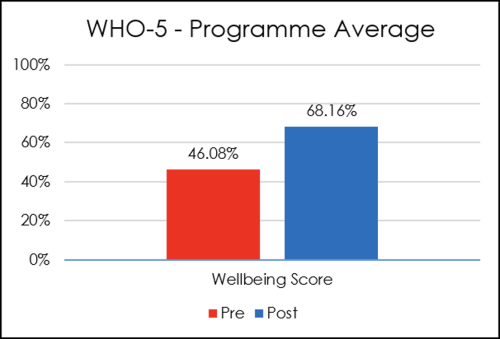
- The participants, on average, reported a large increase in their wellbeing scores, rising from 46.08% before programme delivery to 68.16% after programme delivery.
Mental Health:
DASS-21 (Lovibond & Lovibond, 1995):
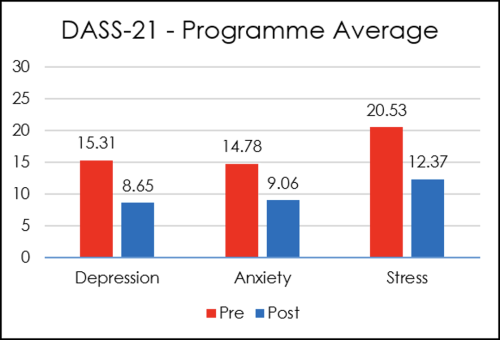
- The participants, on average, reported significant decreases in symptoms of all three measures after the programme delivery, the average falling below the moderate cut-off score for each measure
Relationship With Child:
The ‘Parenting Tunnel’ (Mellow Tool):
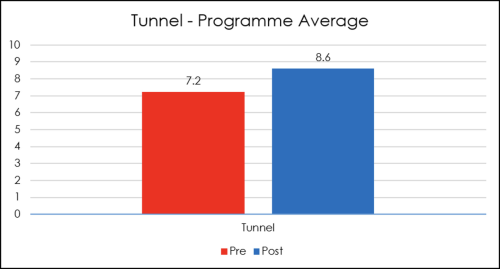
- The participants, on average, reported an increase in rating their relationship with their child, the average increasing from 7.2 pre-programme to 8.6 post-programme.
Parenting Confidence:
KPCS (Črnčec, Barnett, Matthey, 2008):
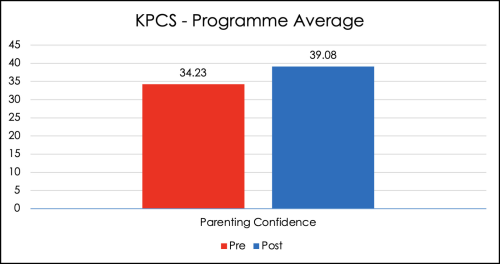
- The participants, on average, reported an increase in their parenting confidence, their scores increasing from 34.23 pre programme to 39.08 post programme.
Voices of Parents
|
Statement |
Strongly Agreed |
Agreed |
Total |
|
“I would like to keep in touch with the service that delivered the programme” |
64% |
32% |
96% |
|
“After taking part in the group I feel better about myself” |
55% |
34% |
89% |
|
“I found the topics in the programme relevant to me and my family situation” |
68% |
23% |
91% |
|
“The group has given me a new perspective on my relationships” |
60% |
36% |
96% |
|
“The group has helped me identify my personal strengths” |
52% |
39% |
91% |
“I found it great it made me realise my self worth and how negative the environment I was in during the group and how the group managed to help me move on from the environment . I felt the other mums really supported me. <Practitioners Names> were supportive and I could talk to them about anything.”
- Mum, 32, West Lothian.
“The group has helped me realise things are not going to get fixed over night. However, I have been able to build positive relationships with the practitioners and this has helped me to begin to trust other professionals and make the first steps to contacting my GP for further support.”
- Dad, 29, Fife.
“Really helpful made me get out more and feel better within myself and as a parent. I was worried and anxious at the start but glad I gave it a chance as it was a really good experience and always looked forward to group.”
– Mum, 23, Fife.
“I would recommend the group to everyone, it’s not been long enough. I’m more confident within myself and don’t let other people’s views and opinions affect me as a parent.”
– Mum, 31, Fife.
“There’s more love between us. The relationship is closer. We understand each other more.”
— Parent in research study, Davidson et al. 2022
“I was isolated before. I had nobody. And now I’ve got a group of friends.”
— Parent in research study, Davidson et al. 2022